The Rise of the T-Shaped Marketer: Why Depth Alone Won’t Save You in the Age of AI
For years, the marketing world has been haunted by a single, persistent fear: AI is coming for our jobs.
A familiar whisper in every PPC forum, every Slack group, every agency stand-up.
But here’s the twist: most people aren’t ready to hear.
AI isn’t replacing marketers. It’s replacing mediocre ones.
What we’re witnessing is not the death of marketing jobs—it’s the death of narrow specialization. And in its place, a new archetype is taking over the industry: the T-shaped marketer.
The future doesn’t belong to the person who knows the Google Ads dashboard pixel by pixel. It belongs to the marketer who knows the dashboard and understands landing pages, writes strong creative, interprets analytics, diagnoses funnel problems, advises on offers, collaborates with sales, and still has the critical thinking ability that AI can’t replicate.
The age of “I only do Google Ads” is fading fast.
The age of “I improve business outcomes” is here.
Why Specialization Became a Trap
We were once told that hyper-specialization is the fastest way to stand out. “Own a niche,” they said. “Become world-class at one thing.”
But AI rewrote the rules.
Today, Google Ads specialists are competing not only with each other—but with automated systems that do the grunt work better and faster:
- Auto-bidding
- Auto-targeting
- Auto-creative generation
- Auto-optimizations
The platform now does what junior PPCs used to do manually.
The result?
The narrower your skill set, the easier you are to replace.
Not by a person—by a machine.
And clients feel it too. They don’t want someone who “manages Google Ads.”
They want someone who says:
“Your landing pages are slowing down performance.
Here’s how to fix them, here’s how to reposition the offer, and here’s how I’ll optimize your funnel so the ads actually convert.”
The marketer of the future is not a channel operator.
The marketer of the future is a strategist disguised as a specialist.
The T-Shaped Marketer: Not a Buzzword—A Survival Strategy
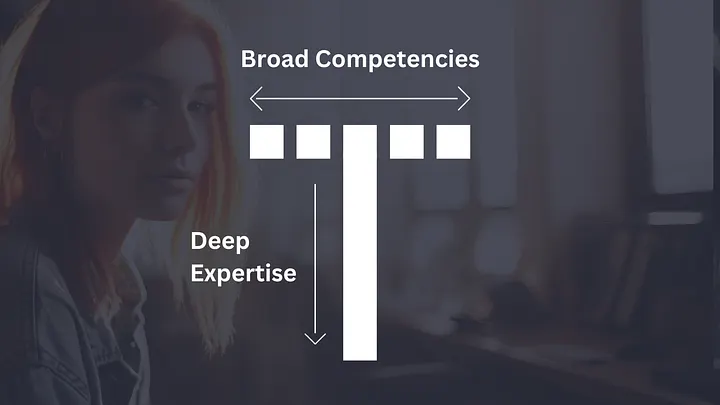
A T-shaped marketer goes deep in one primary discipline—say Google Ads—but stacks other complementary skills horizontally:
- CRO and landing page design
- Copywriting and creative direction
- Data analytics and visualization
- Meta/LinkedIn/TikTok advertising
- Technical tracking & attribution
- Offer strategy and funnel design
- Basic automation and AI tools
This combination—the depth plus breadth—creates something AI can’t mimic.
- AI can adjust bids.
AI can generate 50 variations of an image.
AI can test headlines in seconds.
But AI cannot:
- Read between the lines of client goals
- Redesign an offer to align with market psychology
- Identify why a landing page fails even when the data looks fine
- Craft an original message that moves humans toward action
- See patterns across creative, funnel, and customer behavior with real business nuance
This is why T-shaped marketers rise while narrow specialists stall.
They don’t compete with automation—they command it.
Stackable Skills: The New Currency of High-Value Marketers
Campaign management used to be the job. Now it’s the minimum entry ticket.
The marketers who thrive will be those who deliberately stack skills that multiply their impact.
Here’s what that looks like in practice:
- Conversion Rate Optimization & Landing Pages – Because fixing a broken landing page can outperform a month of bid management.
- Creative & Copywriting – Because algorithms distribute, humans decide.
- Analytics & Attribution – Because whoever controls the data controls the narrative—and the strategy.
- Multi-Platform Fluency – Because channel synergy is underrated, and business leaders expect holistic thinking.
- Automation & AI Tools – Because tools don’t replace talent—they amplify it.
This isn’t about becoming a generalist. It’s about becoming a dangerously effective specialist.
The Mindset Shift Separating Good Marketers from Great Ones
Technical skills matter, but mindset is the real differentiator.
Great PPC pros—those who stay relevant, in demand, and well-paid—operate with a different internal code:
- Extreme Ownership – They take responsibility for the whole customer journey, not only their piece of the puzzle.
- Value Over Vanity Metrics – They don’t chase cheap clicks—they chase business outcomes.
- Relentless Curiosity – They never stop learning, experimenting, or breaking things on purpose to understand them better.
- Holistic Thinking – They don’t blame “bad leads.” They diagnose the system generating those leads.
- Communication Mastery – Because simplifying complexity is how you build trust, influence decisions, and stay indispensable.
This mindset can’t be automated. It can only be cultivated.
Finding Your “Edge”: The Intersection That Makes You Uncopyable
Most marketers don’t have a skill problem.
They have a self-awareness problem.
Your unique career path lies at the intersection of:
- What you’re naturally good at
- What energizes you
- What creates business value
- What clients will pay for
- What AI can’t easily replicate
For some, the “edge” is storytelling.
For others, it’s numbers, systems, design, psychology, or persuasion.
Once you identify your strengths, double down.
Turn them into your competitive moat.
In an automated future, your uniqueness becomes your currency.
But What About Fully Automated Ads? Are They Coming?
Meta is pushing aggressively toward “goal-only” campaign creation by 2026.
Google is heading the same direction.
Yes—full-funnel automation for simple ad accounts is likely.
But here’s the nuance most headlines ignore:
Automated ads work best for:
- High-volume data
- Simple product catalogs
- Small businesses with basic goals
- Brands that don’t need differentiation
But for real strategy, high-stakes budgets, nuanced customer journeys, creative direction, or brand building?
Automation cracks under complexity.
AI can run ads.
AI cannot run marketing.
The Future Belongs to the Marketers Who Can Think
The biggest winners won’t be those who resist AI or fear it—they’ll be the ones who use it as leverage.
They’ll say:
- “Let automation free me from repetitive tasks.”
- “Let me focus on strategy, creativity, and problem-solving.”
- “Let me become the multiplier that algorithms can’t replace.”
T-shaped marketers aren’t the future.
They are the present reality.
And the sooner you expand beyond your narrow expertise, the sooner you’ll stop worrying about AI—and start outperforming everyone who does.